


Research


Wearable E-Tattoos and Cardiovascular Monitoring
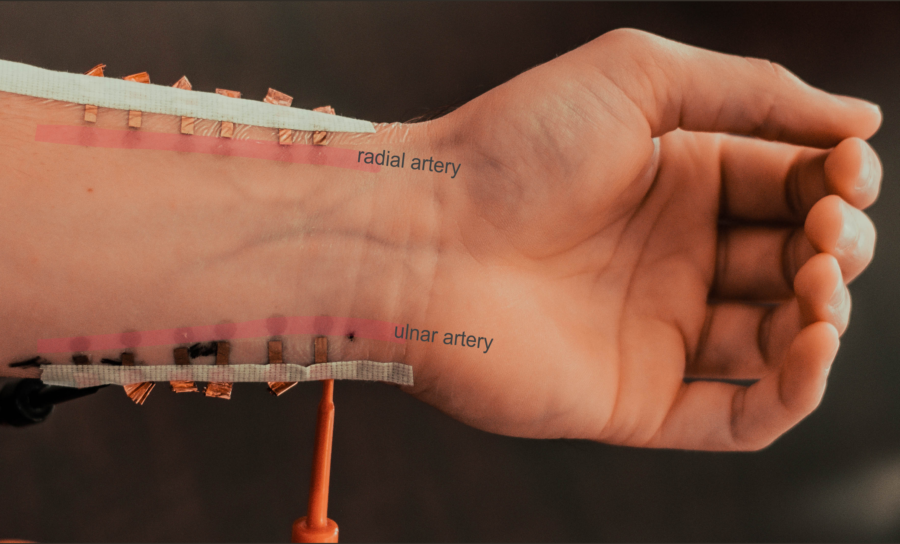
We develop ultrathin 2D electronic tattoos that conform to the skin for continuous physiological monitoring. Our graphene tattoos record electrical and bioimpedance signals, including measurements used for cuffless blood-pressure tracking. We combine materials engineering, wearable electronics, and signal analysis to study cardiovascular function, with ongoing work extending toward monitoring during daily activity and sleep. Related projects investigate soft graphene interfaces for recording and stimulating the heart.
Ultrasensitive GFET Biosensors
Graphene field-effect transistors (GFETs) translate molecular interactions at their surface into electrical signals. We engineer these interfaces for sensitive and selective detection of proteins, nucleic acids, and other biomarkers. Our research combines surface functionalization, antifouling chemistry, multiplexed arrays, and portable readout electronics. Current directions include biomarker panels for cancer, neurodegenerative disease, and immune-related conditions, with an emphasis on analytical validation and a practical pathway toward early detection.

Sweat Biosensors
We are developing wearable GFET biosensors that measure biochemical signals in sweat. These devices combine molecular recognition with transistor architectures designed to operate at the skin interface. We explore how sweat composition, sample availability, and sensor stability affect measurement reliability. Our goal is to complement electrophysiological recordings with biochemical information for repeated, noninvasive monitoring.

Conductive Wearables and Skin Interfaces
We develop soft conductive materials that maintain electrical contact with skin as the body moves. Our work includes atomically thin 2D materials, conformal hydrogel electrodes, bioelectronic circuits, and other approaches.

2D Materials and Device Engineering
Atomically thin materials offer a versatile foundation for bioelectronics. We study graphene, MoS₂, PtSe₂, and PtTe₂, connecting their electronic and electrochemical properties to device performance in biological environments. Our work includes material transfer, flexible device fabrication, electrolyte gating, and rapid prototyping. These studies help us identify suitable materials and device structures for sensors, electrodes, and biohybrid systems.

Neuromorphic Bioelectronics
We build BLASTs - electronic devices that reproduce aspects of synaptic memory and dendritic signal processing. Our graphene synaptic transistors use ionic and electronic interactions to produce tunable conductance and learning-like behavior. We investigate how these devices can combine sensing, memory, and computation within the same physical structure, with longer-term interests in adaptive biointerfaces and communication between living systems and artificial networks.
Interestingly, the same approaches also work on plants, leaves, and other biotic and abiotic interfaces.

Living Biointerfaces & Neurotechnologies
We develop flexible 2D electrodes and transistor arrays for recording electrical activity from cells, neural tissues, and cardiac tissue. Our research studies material properties, device geometry, and tissue contact affect signal quality and biological compatibility. Collaborative work also show graphene optoelectronic actuators for non-genetic modulation of cellular activity. These technologies support studies of biological tissues and the development of interfaces for recording and stimulation.

Biohybrid Systems and Organoids
We are also exploring how electronic interfaces can support long-term measurements and controlled stimulation of three-dimensional biological models. Our emerging biochipset-organoid direction brings together soft bioelectronics, cellular systems, and neuromorphic devices. The goal is to follow how biological networks develop and respond to perturbations, with future applications in disease modeling, drug screening, and biohybrid computation.
